
Last updated: 6 October 2026
TL;DR
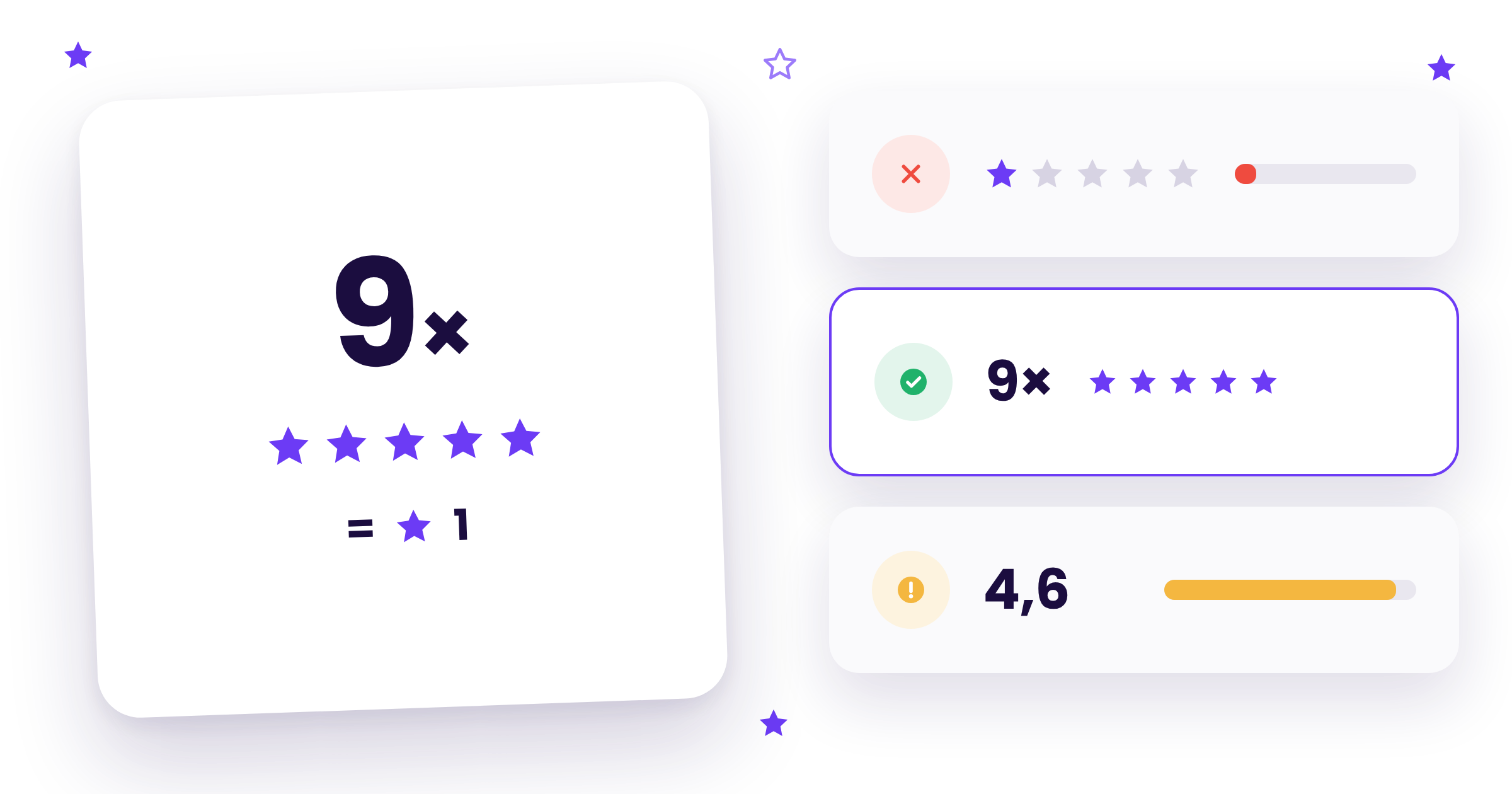
- The number of five-star reviews needed to offset one one-star review depends only on your current average: nine at a 4.6, nineteen at a 4.8.
- How many reviews a profile already has does not change that ratio; it only decides how hard a single one-star hits in the short term.
- Over time a star rating drifts towards the average of the reviews coming in now, so dealer groups manage the inflow instead of trying to compensate.
- In Repmanager you request reviews per dealership with invitations and QR codes, and the dashboard shows each dealership's average against your target.
How many five-star reviews offset one one-star review?
It depends on your current average. The formula is simple: take your average minus 1, and divide it by 5 minus your average. At 4.6 that is 3.6 divided by 0.4, so nine five-star reviews. At 4.8 it is nineteen. The higher your rating, the more each one-star costs you.
Here is a worked example. A dealership has 300 reviews and an average of exactly 4.6. That adds up to 1,380 stars. A one-star review arrives: 1,381 stars over 301 reviews gives 4.59. Then nine five-star reviews come in: 1,426 stars over 310 reviews, and you are back at exactly 4.6.
The surprising part: the number of reviews you already have does not appear in the formula. Whether you have 50 or 5,000 reviews, at 4.6 you need nine fives for every one-star.
In real life, not every new positive review is a five. If your new positive reviews average 4.8, you need eighteen of them per one-star at a 4.6, not nine. That is the honest version of the sum.
| Current average | Five-stars needed per one-star | Five-stars needed per two-star | Per one-star if new reviews average 4.8 |
|---|---|---|---|
| 4.2 | 4 | 2.8 | 5.3 |
| 4.4 | 5.7 | 4 | 8.5 |
| 4.5 | 7 | 5 | 11.7 |
| 4.6 | 9 | 6.5 | 18 |
| 4.7 | 12.3 | 9 | 37 |
| 4.8 | 19 | 14 | Not possible: you drift down to 4.8 |
Is it true you need 100 positive reviews for every 10 negative ones?
Roughly, yes. At an average of 4.6, ten one-star reviews take ninety five-star reviews to offset; at 4.7 it takes 123. So "ten negative, a hundred positive" is about right for a dealership sitting between 4.6 and 4.7. The conclusion people usually attach to it is wrong.
A dealer group with a sizeable network of dealerships put it like this: "For ten negative reviews we probably need to get a hundred positive ones. You just can't recover from that." The first half is correct. The second half assumes a dealership that waits for reviews instead of asking for them.
A hundred reviews is not a year's work for a busy dealership. After an email campaign, Bochane Groep received 80 reviews in a single day, as described in the Bochane case. If you ask every customer for a review as a matter of routine, you reach those numbers in weeks or months, not years.
What does one one-star review cost with few or many reviews?
In the long run the same; in the short run far more on a small profile. A dealership with 50 reviews at 4.6 drops to 4.53 after one one-star, which rounds to 4.5. With 500 reviews it moves to 4.59 and still shows 4.6. A small profile feels every complaint straight away.
With ten one-stars the gap widens. With 100 reviews at 4.6 you fall to 4.27. With 1,000 reviews you stay at 4.56. That is why dealerships with few reviews panic most after a bad week, even when the service has not got worse. How many reviews you need for a stable rating is covered in how many reviews do you need.
How many reviews does it take to go from 4.6 to 4.7?
With five-stars only: a third of what you already have. At 4.6 with 300 reviews, you need 100 five-star reviews to reach 4.7. If new reviews average 4.8, you need as many as you already have: 300. Moving up a tenth of a star takes serious volume.
That is the main lesson of the maths. Over time an average drifts towards the average of what is coming in now. If reviews arriving each month average 4.8, your profile slowly moves there, whatever happened in the past. "How do we compensate?" is the wrong question. The right one is what your inflow looks like. What counts as a healthy rating, and why a perfect 5.0 looks suspicious, is covered in what is a good average review score.
What works better than offsetting negative reviews?
Two things: asking every customer for a review as standard practice, and visibly following up on every complaint. The first changes your inflow, so your average starts to reflect how customers really experience you. The second changes what a reader sees under that one-star. Both can be organised, even across dozens of dealerships.
There is one hard rule when you ask: ask everyone, not only the happy customers. Checking satisfaction first and then sending only the happy ones to Google is called review gating, and Google's review policy does not allow it. Your satisfied majority is big enough; it just does not write reviews unprompted.
Among the dealer groups working with Repmanager we see two schools. One puts a QR code or NFC tag at the service desk and asks at the moment the customer collects their keys. That works better than an email afterwards. The other deliberately asks for no reviews at all, because the importer's customer survey already takes up that contact moment. That group leaves the maths entirely to chance.
The second part is replying. A one-star with a calm, personal reply carries less weight for a reader than a one-star left unanswered. How often complaints go unanswered was shown by the complaint gap. And a three-star review with a good reply is sometimes updated to four or five stars. You cannot promise it, but it happens.
Finally, look at the source. A one-star for "impossible to reach" is often a workshop call-back request that was never picked up. One complaint fewer at the source saves you nine five-star reviews at a 4.6.
How do you set this up in Repmanager?
You set up two things: a steady flow of invitations per dealership, and a fixed route for low ratings. After that, the dashboard shows per dealership whether the average is moving towards your target.
- Open Invites and send review invitations by email, per location and per platform (Google or Klanten Vertellen). The overview shows when each invitation was sent and whether the link was clicked.
- Generate a QR code per location and print it for the sales desk, the service reception or the handover area.
- Let reply rules handle positive reviews, for example automatically on four and five stars, so your time goes to the low ratings.
- In Reviews, work from the Open and Urgent tabs so no one- or two-star review is left without a reply.
- Set a target for the average rating under Settings → KPI targets, for example 4.5, and check the location table on the Dashboard for dealerships below target.
- Look at Top complaints per dealership, with the trend against the previous period. That tells you which source of complaints to tackle first.
What usually goes wrong?
Only asking happy customers. It feels clever, but it is review gating and it breaks the rules. Ask everyone.
One campaign, then nothing. A mailing gives you a spike, but once the inflow dries up your average drifts back to whatever comes in unprompted. And unprompted reviews come mostly from unhappy customers.
Managing on the group average. Twenty dealerships lumped together hide the one with 40 reviews that drops below target after three complaints. Look per dealership.
Leaving a complaint because it "can't be fixed anyway". You win the average back with volume. You only win the complaint back with a reply.
Frequently asked questions
Can you get a negative review removed?
Only if it breaks Google's policy, for example spam, fake reviews or a conflict of interest. A fair but negative review stays. You can only reply to it, and that almost always works better than trying to get it taken down.
Does a two-star review weigh less than a one-star?
Yes. At an average of 4.6 you offset a two-star with 6.5 five-star reviews, against nine for a one-star. That is just over a quarter less, but a two-star still hurts.
Why is my rating dropping when the service has not got worse?
Often it is volume. Negative reviews peak in busy workshop months, such as May and October when customers switch tyres. More customers means more chances of a complaint, even at the same level of service.
Ready to set it up?
Managing several dealerships and want to see how each one's average develops? In a 15-minute demo we show how dealer groups set up invitations and replies per dealership.