
Last updated: 6 October 2026
TL;DR
- The same location scores differently on Google, Trustpilot and local review platforms because each platform attracts different reviewers, invites differently, uses a different scale and has different rules on who may review.
- Google and Trustpilot are open platforms where anyone with an account can post. Many countries also have local verified-review platforms, where only customers with a verifiable experience can review, usually after an invitation from the business.
- A business that does not invite customers on an open platform such as Trustpilot mainly gets unprompted reviews from unhappy customers there, so that score comes out lower than actual customer satisfaction.
- Repmanager brings Google Business Profile and, for the Netherlands, Klanten Vertellen and Kiyoh together in one timeline, with invitations per platform; Trustpilot is not one of the standard integrations.
Why does one location's score differ per review platform?
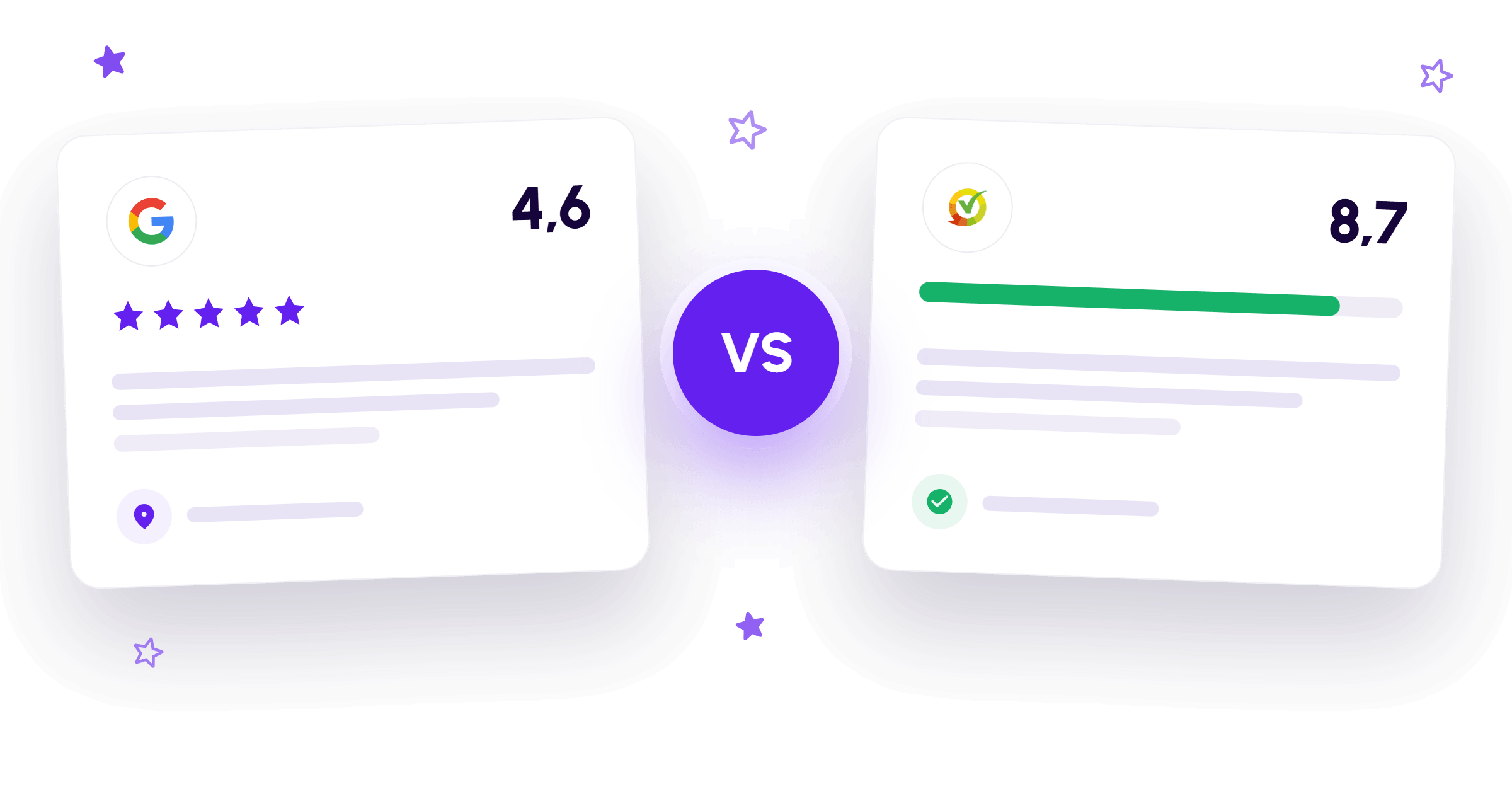
Because each platform measures a different group of customers. Who reviews, whether they were invited, which scale they score on and whether they have to be a customer all differ by platform. A score is therefore not an objective grade for your dealership, but a grade from the people who chose to give their opinion on that platform.
One Dutch dealer group put the problem bluntly: "If you look at our rating on Trustpilot, you'd honestly think, what a [terrible] company." The same group scores well elsewhere. The service is not different, the sample is. Once you see that, you stop comparing the numbers and start looking at what each platform actually measures.
What is the difference between open and verified review platforms?
Google and Trustpilot are open platforms: anyone with an account can review a genuine experience, without an invitation. Verified-review platforms work differently: the business invites the customer, the platform verifies, and only people with a verifiable experience can review. Many of these platforms are local. In the Netherlands, for example, Klanten Vertellen and Kiyoh are widely used. Scales differ too: Klanten Vertellen scores out of 10, Google and Trustpilot out of 5 stars.
Car dealers also deal with industry review sites, for example DealerRater in the US or Auto Trader reviews in the UK. Each has its own rules on who may review and how scores are shown, so the same logic applies: know what the platform measures before you compare.
| Trustpilot | Local verified platform (for example Klanten Vertellen) | ||
|---|---|---|---|
| Who may review | Anyone with a Google account and a genuine experience | Anyone with an account and a recent, genuine experience | Only customers with a verifiable experience |
| Invitation needed | No | No | Usually, via the business |
| Scale | 1 to 5 stars | 1 to 5 stars | Differs per platform; Klanten Vertellen uses a score out of 10 |
| Who reviews unprompted | Happy and unhappy customers, visitors | Mostly those who make the effort, often with a complaint | Hardly anyone, it runs on invitations |
| Role for the dealer | Visibility in Search and Maps, often the manufacturer's KPI too | Trust among people comparing online | Verified trust, score on your own site |
Trustpilot's guidelines say an experience does not have to be a purchase: a phone call or a visit also counts, as long as it happened in the last twelve months. Google requires a genuine experience with the place or business. How a local verified platform works in practice is explained in what is Klanten Vertellen.
Why does a dealer often score lower on Trustpilot?
Because without invitations you get negative selection. A happy customer collecting their car does not think of Trustpilot. A customer with a problem looks for a place to tell their story, and finds the open platform. If the dealer does not actively invite there, the score mostly consists of people who had something to complain about.
On a verified platform it works the other way round. The dealer sends an invitation after handover or a workshop visit, and it goes to ordinary customers, most of them satisfied. That gives a broad sample with a higher average. Google sits in between: some reviews follow an invitation, some are unprompted. That is not manipulation; it is the difference between a sample you steer and one that selects itself.
To narrow the gap between platforms you have two levers: invite the same way everywhere, or accept that each platform measures something different. Which platforms beyond Google are worth your time is covered in Trustpilot, Facebook and other review platforms.
Is a 9 out of 10 on a local platform the same as a 4.5 on Google?
No. You cannot simply halve a score out of 10. The scales measure different groups of customers at different moments, and an invited customer judges differently from someone writing on their own initiative. A 9 on a verified platform and a 4.3 on Google can both be a fair picture at the same time.
There is also a level difference. Many dealer groups run their verified-review account at organisation level, while Google works per dealership, often with one profile per brand. Then you are comparing one group score with dozens of dealership scores. The manufacturer or importer (the brand) usually looks at scores and response rates per dealership, and which of those count for your brand is covered in manufacturer and importer KPIs for reviews.
What do dealer groups do with different scores?
They give each platform a role and manage it accordingly. This is how dealer groups do it: Google is the platform for visibility and usually for the manufacturer, the verified platform for trust on their own site, and Trustpilot is kept up wherever customers actively use it. The odd group splits channels on purpose, for example new cars through one platform and used cars through another.
There are two schools. One group invites everywhere, so no platform only collects complaints. The other sticks to Google and one verified platform and only replies on Trustpilot to what comes in, so the invitation flow does not fragment. Both work, as long as nobody plays the scores off against each other in the boardroom. What never works: leaving Trustpilot reviews unanswered because it is "not our platform". A complaint without a reply reads the same everywhere. How to answer one is covered in how to respond to negative reviews.
How do you set this up in Repmanager?
In Repmanager, Google Business Profile reviews come together per dealership in one timeline. If you use Klanten Vertellen or Kiyoh, review platforms widely used in the Netherlands, their reviews join the same timeline. You send invitations per platform, so you steer the sample and see the scores side by side. For the dealer groups working with Repmanager, mostly in the Netherlands, we set it up like this:
- Connect the Google profiles per dealership via Settings, Locations, Add, Google My Business.
- If you use Klanten Vertellen, connect it with the API key from your own Klanten Vertellen account, at organisation level or per dealership, depending on how yours is set up. Kiyoh is also available under Connections.
- In Invites, send an email invitation per dealership and choose the platform, for example Google or Klanten Vertellen. Generate a QR code per location for the front desk.
- In Reviews, filter by organisation, location or platform to see which reviews are still open where.
- In the Dashboard, track average rating, response rate and response time per dealership against your targets.
How the Klanten Vertellen integration works is covered on its integration page. For Google, see the Google integration. More on sending review invitations is on the feature page. That is also where you see how to manage multiple locations. The dashboard shows the scores per location side by side.
What usually goes wrong?
Averaging scores from different platforms in one report. An average of a score out of 10 and stars out of 5 means nothing. Report per platform.
Only inviting on the platform with the highest score. The gap grows and the other platform looks even worse.
Ignoring Trustpilot. An open platform without replies suggests nobody is home.
Expecting verified-platform scores per dealership when the account runs at organisation level. Check how the account is set up when you connect it.
Frequently asked questions
Can a local review platform show stars in Google?
Some can. Klanten Vertellen, for example, describes itself as an official Google Review Partner and shows scores in Google results, including organic results and ads. That is separate from the reviews on your Google Business Profile.
Which score counts for the manufacturer?
It differs per brand. In practice manufacturers often look at Google per dealership, sometimes alongside their own customer survey. Check with your manufacturer or importer.
Can I reply to Trustpilot reviews in Repmanager?
Trustpilot is not one of the standard integrations on the integrations page. You therefore reply to Trustpilot reviews in Trustpilot itself.
Do I need to be active on every platform?
No. Give each platform a role. Do manage what you have, because an unmanaged profile full of unanswered complaints does more harm than no profile.
One overview for Google and your local review platform?
Managing several dealerships on Google and on Klanten Vertellen or Kiyoh? In a 15-minute demo we show how to manage those platforms per dealership in one timeline.