
The premium paradox is that the pricier the brand, the bigger the complaint gap. The Automotive Google Review Study by Repmanager (204,976 Google reviews of the 30 largest dealer groups in the Netherlands) shows that premium dealers answer 29 percent of their reviews, against 62 percent at mainstream dealers. Not because premium wrenches worse, but because premium answers least.
The term "the premium paradox" was introduced in the Automotive Google Review Study 2026 by Repmanager.
That is striking, because these are the brands where the customer pays the most and expects the most. Yet it is exactly there that the public reputation is in the worst shape. The complaint gap at premium brands is 61 percent, against 49 at mainstream.
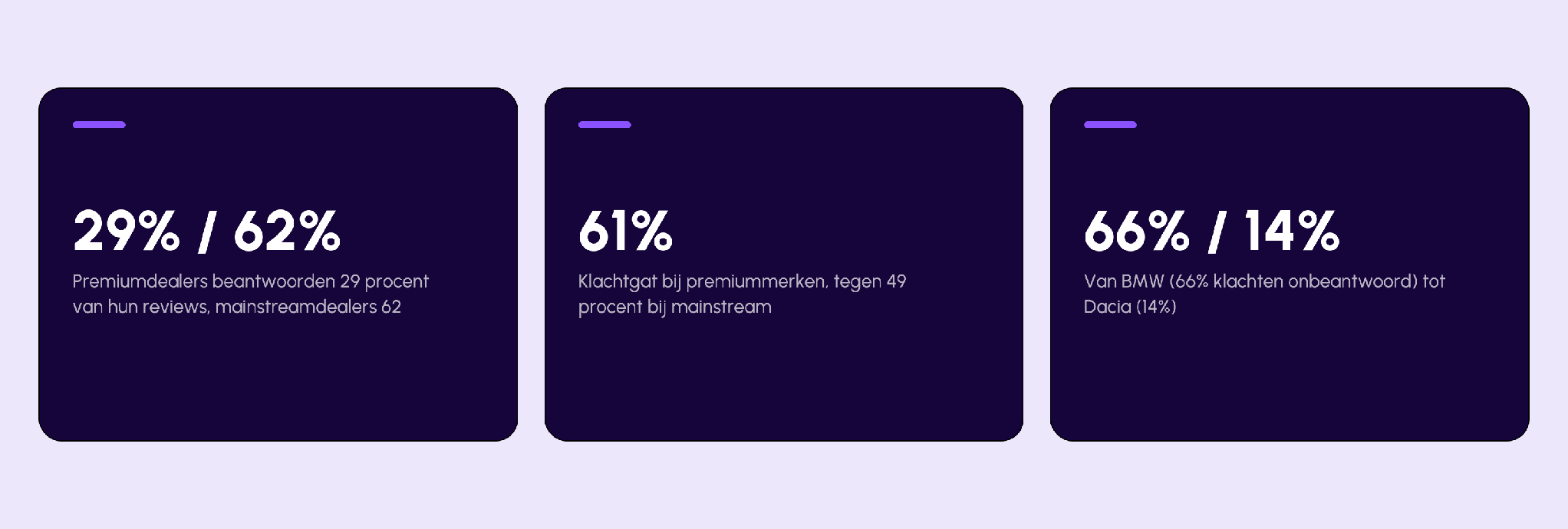
| Key figure | What it means |
|---|---|
| 29% / 62% | Premium dealers answer 29 percent of their reviews, mainstream dealers 62 |
| 61% | Complaint gap at premium brands, against 49 percent at mainstream |
| 66% / 14% | From BMW (66 percent unanswered) to Dacia (14 percent) |
The priciest brands answer the least
We categorized the locations of the 30 largest dealer groups by brand category, with premium as a fixed list: BMW, Mercedes-Benz, Audi, Volvo, Lexus, MINI, Porsche, Land Rover and Jaguar. Then we counted per category how many reviews got an answer.
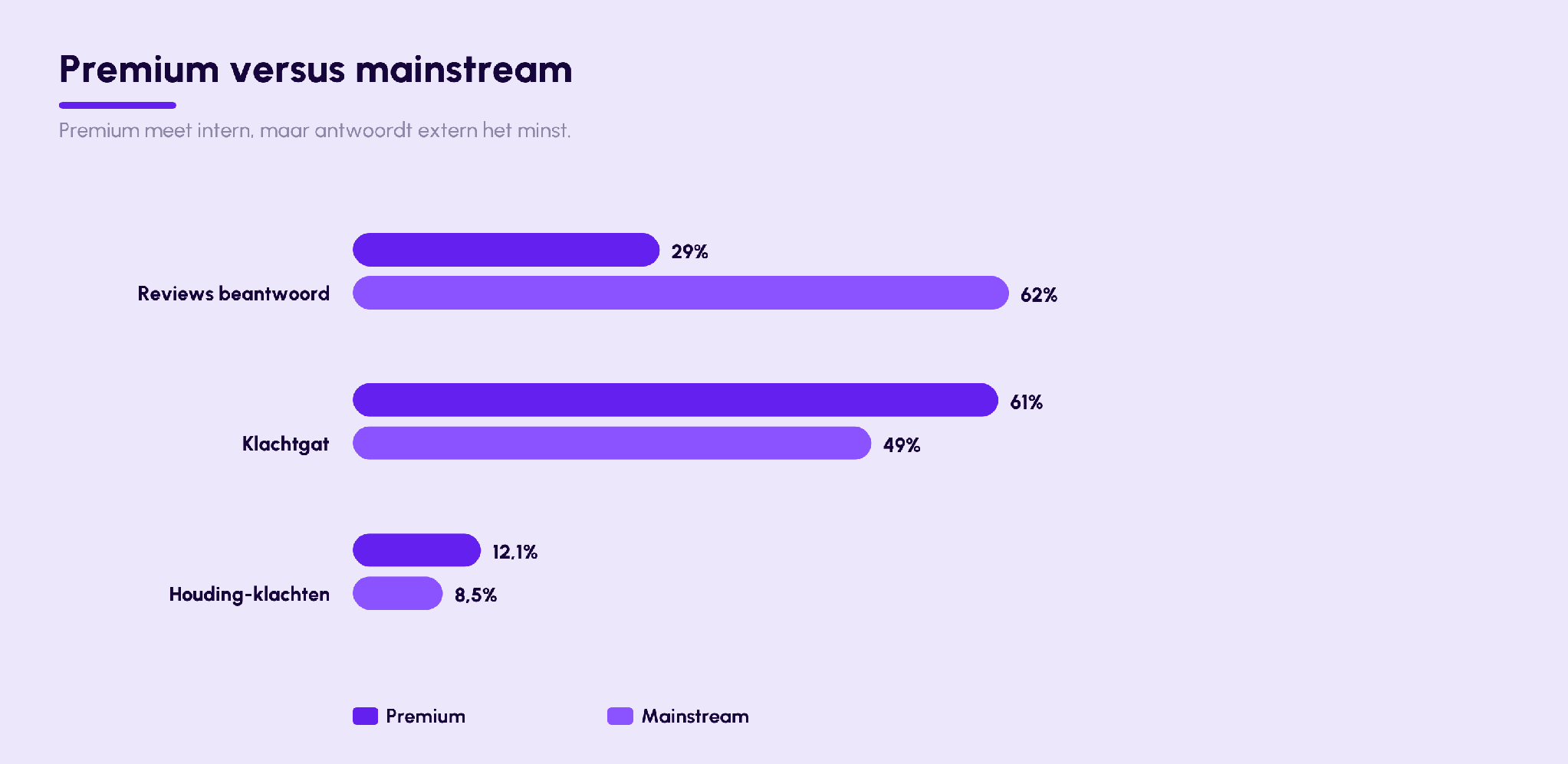
| Category | Premium | Mainstream |
|---|---|---|
| Reviews answered | 29% | 62% |
| Complaint gap | 61% | 49% |
| Attitude complaints | 12.1% | 8.5% |
The difference is large. Across 25,245 reviews at premium brand locations, 29 percent got a response. At mainstream dealers it is 62 percent, more than twice as often. Look at the complaints alone and 61 percent stays unanswered at premium, 49 at mainstream. The customer who paid the most gets the least response when things go wrong.
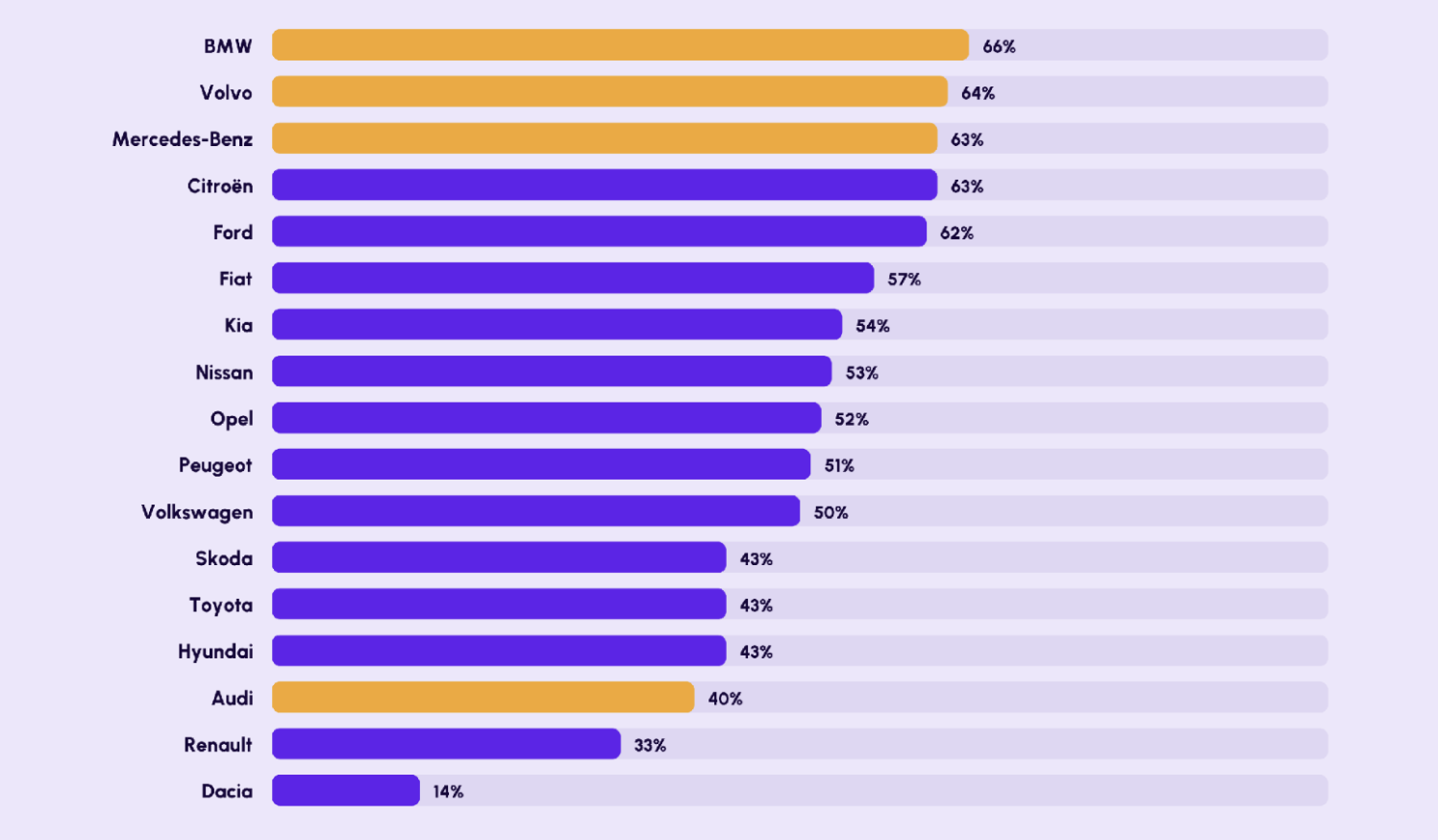
The complaint gap per brand: BMW leaves 66 percent behind, Dacia 14
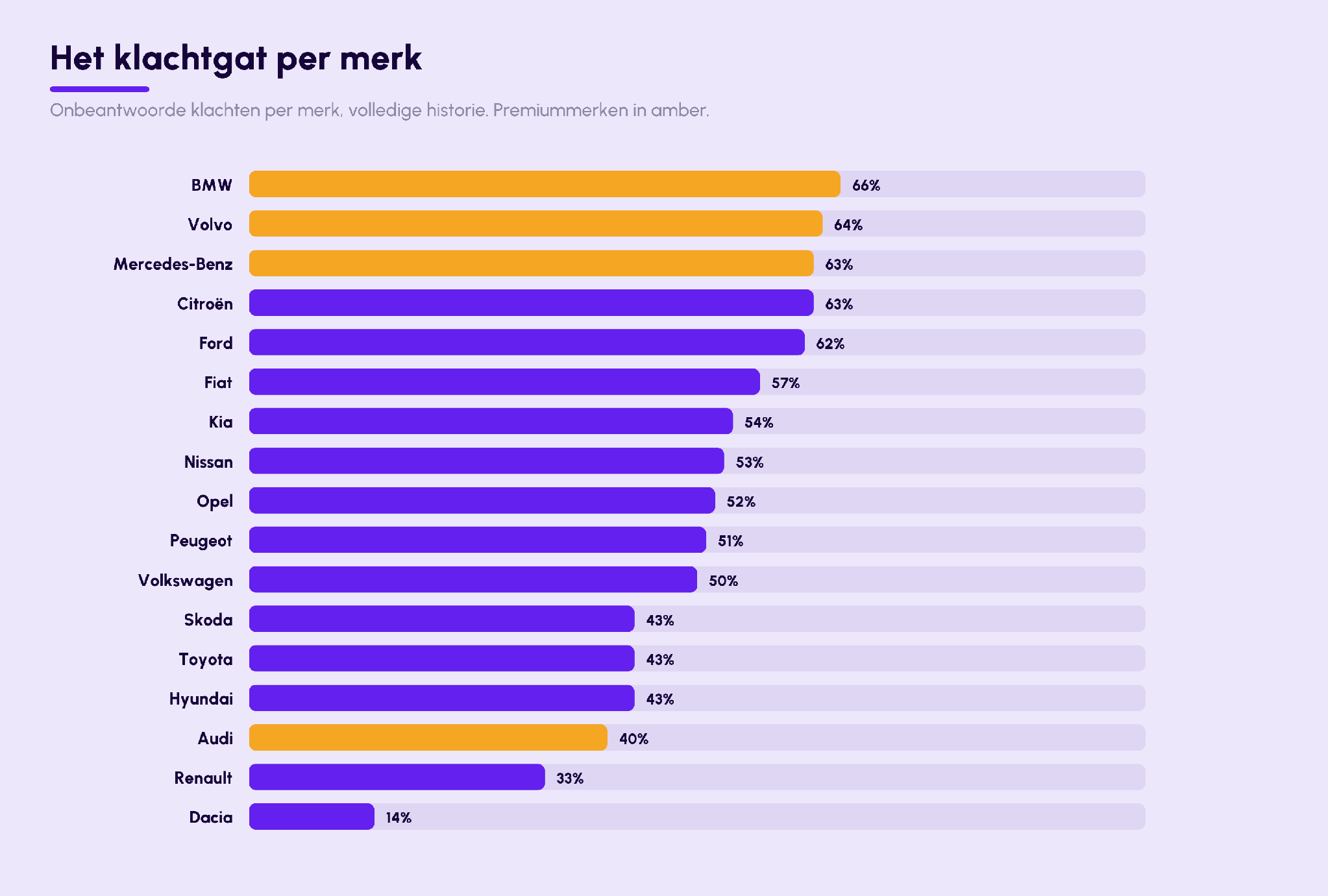
This is the ranking no manufacturer or national importer has on their dashboard: the complaint gap per brand at Dutch dealer groups over the full history, for brands with at least 100 complaints in the dataset.
- BMW (premium): 66 percent
- Volvo (premium): 64 percent
- Mercedes-Benz (premium): 63 percent
- Citroën: 63 percent
- Ford: 62 percent
- Fiat: 57 percent
- Kia: 54 percent
- Nissan: 53 percent
- Opel: 52 percent
- Peugeot: 51 percent
- Volkswagen: 50 percent
- Skoda: 43 percent
- Toyota: 43 percent
- Hyundai: 43 percent
- Audi (premium): 40 percent
- Renault: 33 percent
- Dacia: 14 percent
Three of the four biggest complaint gaps are premium. And at the bottom, with by far the smallest gap, sits Dacia. The cheapest brand on the list answers 94 percent of all its reviews and, at 4.80, scores highest of all brands.
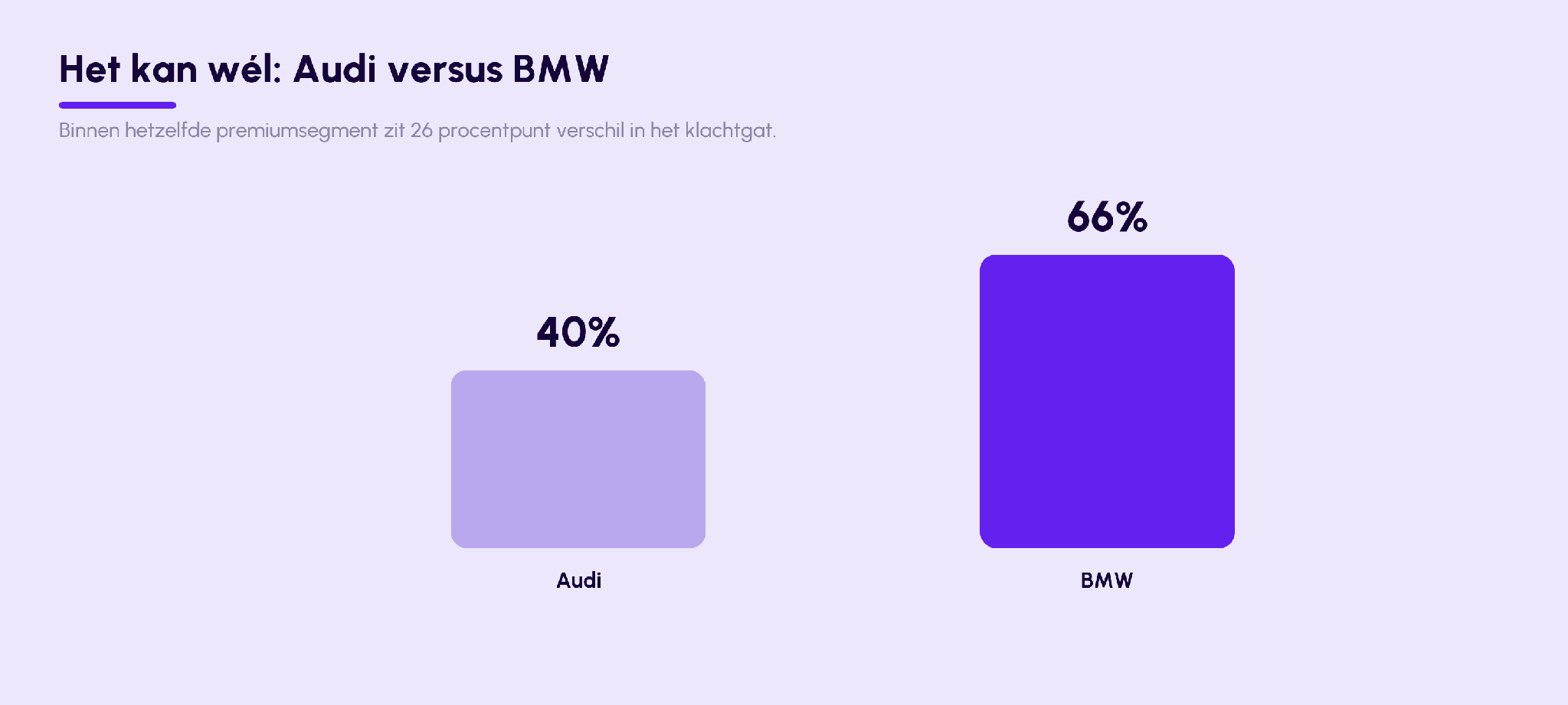
The exception that tests the rule is Audi. At 40 percent, that brand does clearly better than the other premium brands. So it can be done. Within the same segment, the same customer expectation and the same price tag sits 26 percentage points of difference between Audi and BMW. It is not "premium" as a category, it is the choice to answer.
What the premium customer really complains about: the attitude
We read all 14,462 complaints with text and categorized them by topic. At premium and mainstream, complaints are largely about the same things: waiting, the workshop, the price. One theme stands out, and it is telling.
At premium brands, 12.1 percent of complaints with text are about staff attitude. Arrogant, unfriendly, not taken seriously. At mainstream it is 8.5 percent. The word "arrogant" appears 436 times in the complaints of the 30 largest groups. Read them back to back and you see the pattern: the customer feels belittled at the moment they bring in something that hurts them, their broken car and their trust.
A complaint about waiting time is about an incident. A complaint about attitude is about who you are. And that difference grows largest in the workshop: reviews about aftersales score an average of 3.74 at premium, against 4.17 at mainstream. That makes the premium workshop the lowest-rated place in the entire Dutch dealer market. We work out that pattern in the aftersales leak.
The paradox explained: top-level sport inside, silence outside
Our conversations with dealer groups keep producing the same picture. Premium measures service internally, hard: central satisfaction surveys, targets per location, bonuses on the outcome. But that measurement is private. The public review, which every buyer and every AI system does see, often has no owner.
"Internally we hit the targets. But why don't we do that on the outside? That is where customers can't see it." - Marketing Manager of a premium dealer, in conversation with Repmanager
That is the core of the paradox. It is not unwillingness or worse mechanics. It is where the attention is aimed: at the dashboard hanging inside, not at the shop window standing outside.
For manufacturers and importers, this is the opportunity
For the manufacturer (or national importer) this may well be the most useful finding of the study. Response rate and response time are objective, measurable per location and directly steerable. Unlike a star rating, which lags months behind the behavior, this is a KPI you can set today and that the customer actually sees.
The brand ranking above is exactly the kind of figure that belongs in a manufacturer KPI. The share of complaints without an answer is what we call the complaint gap throughout this study.
Answering reviews as a dealer group: why and how
For dealer groups, responding to reviews is not a side issue but a steerable KPI: it is the only behavior in this study that consistently moves with a higher score. Guard response rate and response time per location, give every review an owner and keep the tone in line with your brand. How to organize that across multiple locations is in our guide on automotive reviews.
Start here
Give the public review the same owner and the same target as the internal NPS. What the customer does see deserves at least the attention of what they do not.
The classic mistake: confusing internal satisfaction with external reputation. The NPS sits in a dashboard. The review sits in the shop window, and the AI reads it out loud.
Curious where your dealer group stands?
We benchmark your locations against these figures free of charge: score, response rate, response time and complaint gap, per location. One overview, no obligations.
Frequently asked questions
What is the premium paradox?
The premium paradox is that the pricier the brand, the bigger the complaint gap. In the Netherlands, premium dealers answer 29 percent of their reviews, mainstream dealers 62 percent.
Which brand has the biggest complaint gap?
Among Dutch dealer groups: BMW, with 66 percent of complaints unanswered over the full history. Volvo (64 percent) and Mercedes-Benz (63 percent) follow. Dacia has the smallest gap at 14 percent.
Why do premium brands answer fewer reviews?
Premium measures customer satisfaction tightly internally through surveys, targets and bonuses, but that measurement is private. The public review often has no owner. Top-level sport inside, silence outside.
What does the premium customer complain about more often?
About staff attitude: 12.1 percent of premium complaints with text, against 8.5 percent at mainstream. In the workshop, premium scores 3.74, the lowest-rated place in the market.