
The aftersales leak is the score gap between sales reviews and workshop reviews. The Automotive Google Review Study 2026 by Repmanager (204,976 Google reviews of the 30 largest dealer groups in the Netherlands) shows that reviews about the purchase score an average of 4.27 and reviews about the workshop 3.95.
The showroom wins the customer, the aftersales loses them.
The term "the aftersales leak" was introduced in the Automotive Google Review Study 2026 by Repmanager.
Complaints in the car industry are almost never about the car. They are about waiting, the workshop, the bill and not being called back. And that gap is newer than you think: in 2019 it did not exist.
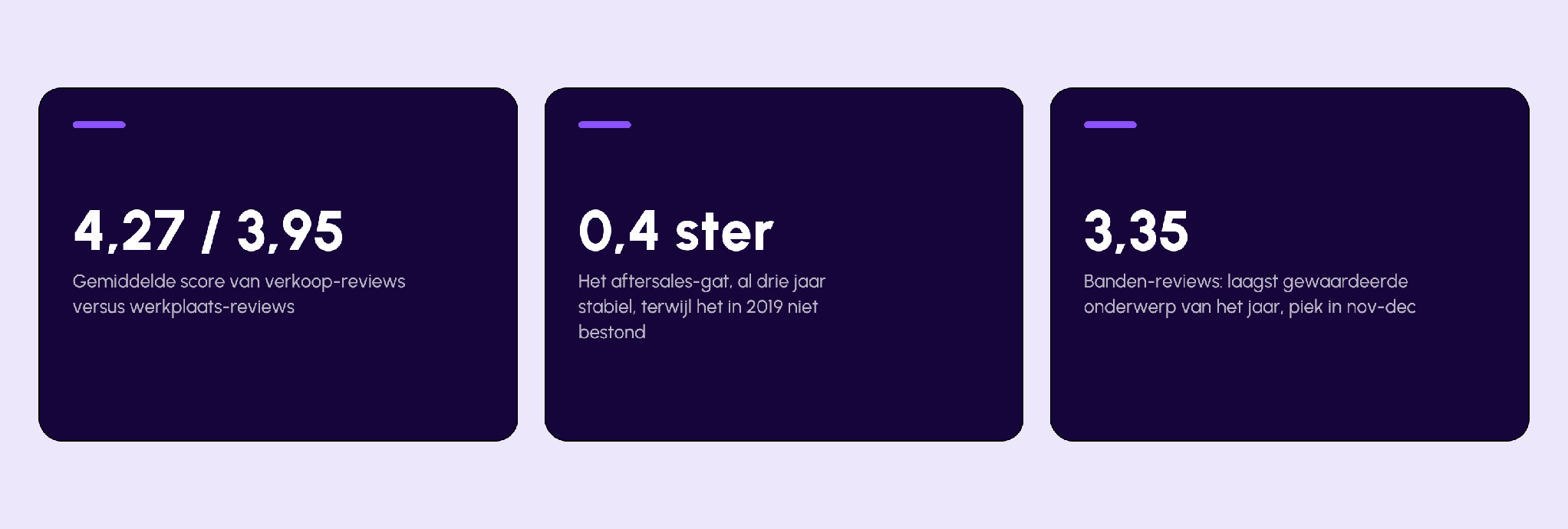
| Key figure | What it means |
|---|---|
| 4.27 / 3.95 | Average score of sales reviews versus workshop reviews |
| 0.4 stars | The aftersales gap, stable for three years (did not exist in 2019) |
| 3.35 | Tire reviews: lowest-rated topic, peaks in November-December |
The showroom wins the customer, the workshop loses them
We split all reviews with text into two groups: reviews about the sale and reviews about the workshop. The difference is consistent. Sales reviews score an average of 4.27 (17,641 reviews), aftersales reviews 3.95 (17,872 reviews). And the reviews that mention both sales and aftersales are the harshest of all at 3.46.
So the pattern is not that the car disappoints, but that the process around it does. The customer buys with pleasure and comes back disappointed to the workshop. That the premium workshop digs the deepest hole here, we already saw in the premium paradox.
What 14,462 complaints are about
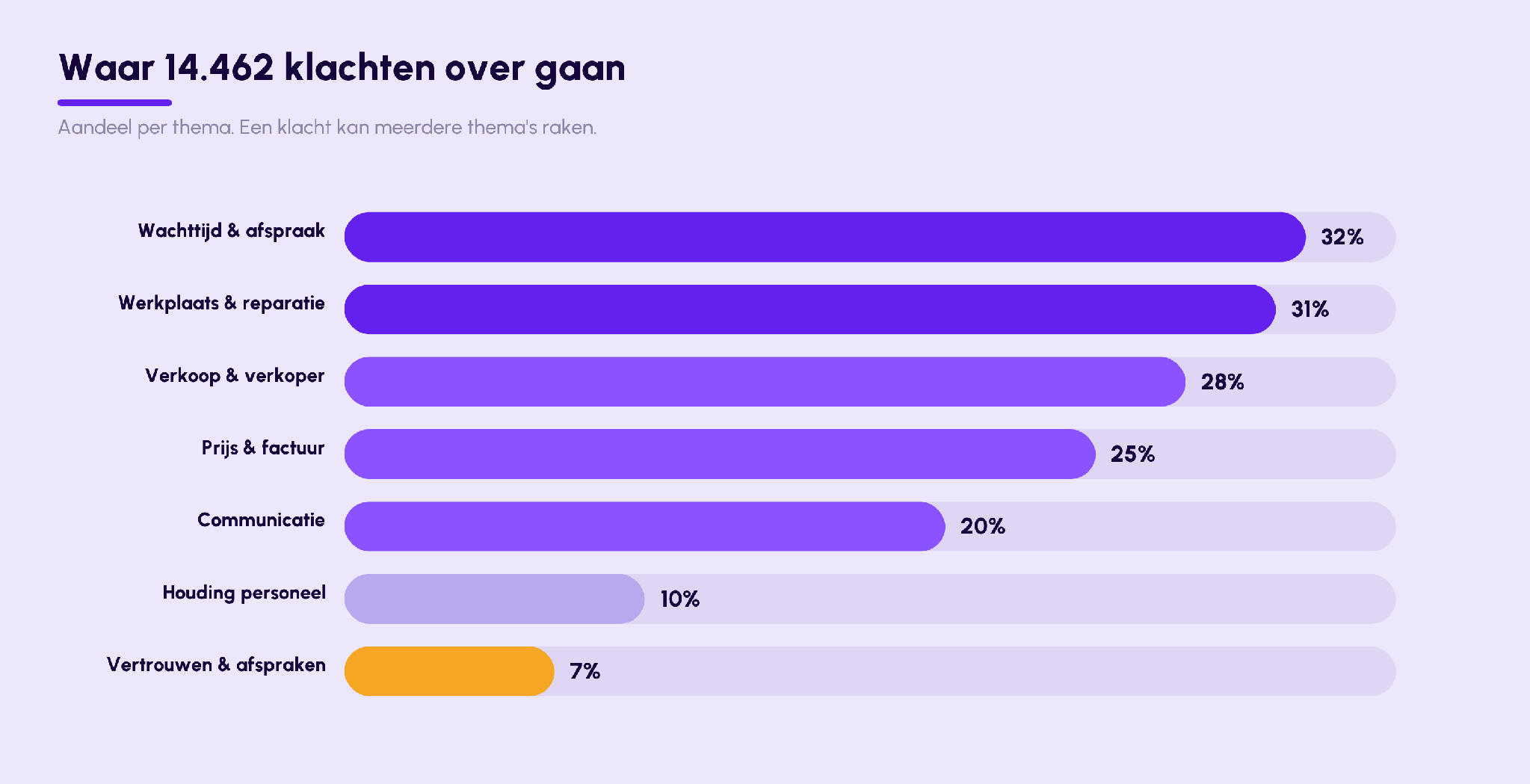
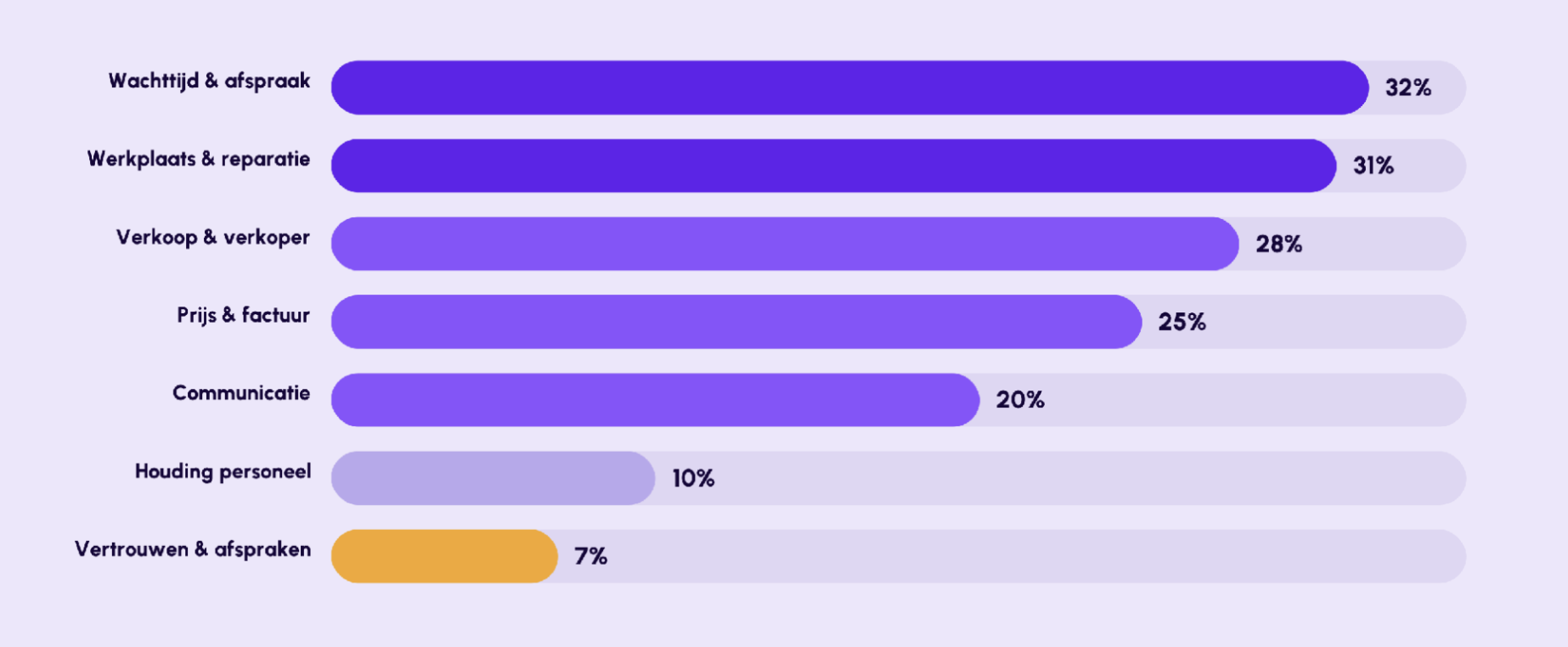
Count the themes across all 14,462 complaints with text and one picture appears: the complaint is almost never about the product and almost always about the process.
- Waiting time & appointment: 32 percent
- Workshop & repair: 31 percent
- Sales & salesperson: 28 percent
- Price & invoice: 25 percent
- Communication & reachability: 20 percent
- Staff attitude: 10 percent
- Trust & promises: 7 percent
(A complaint can touch multiple themes, so the percentages do not add up to 100.)
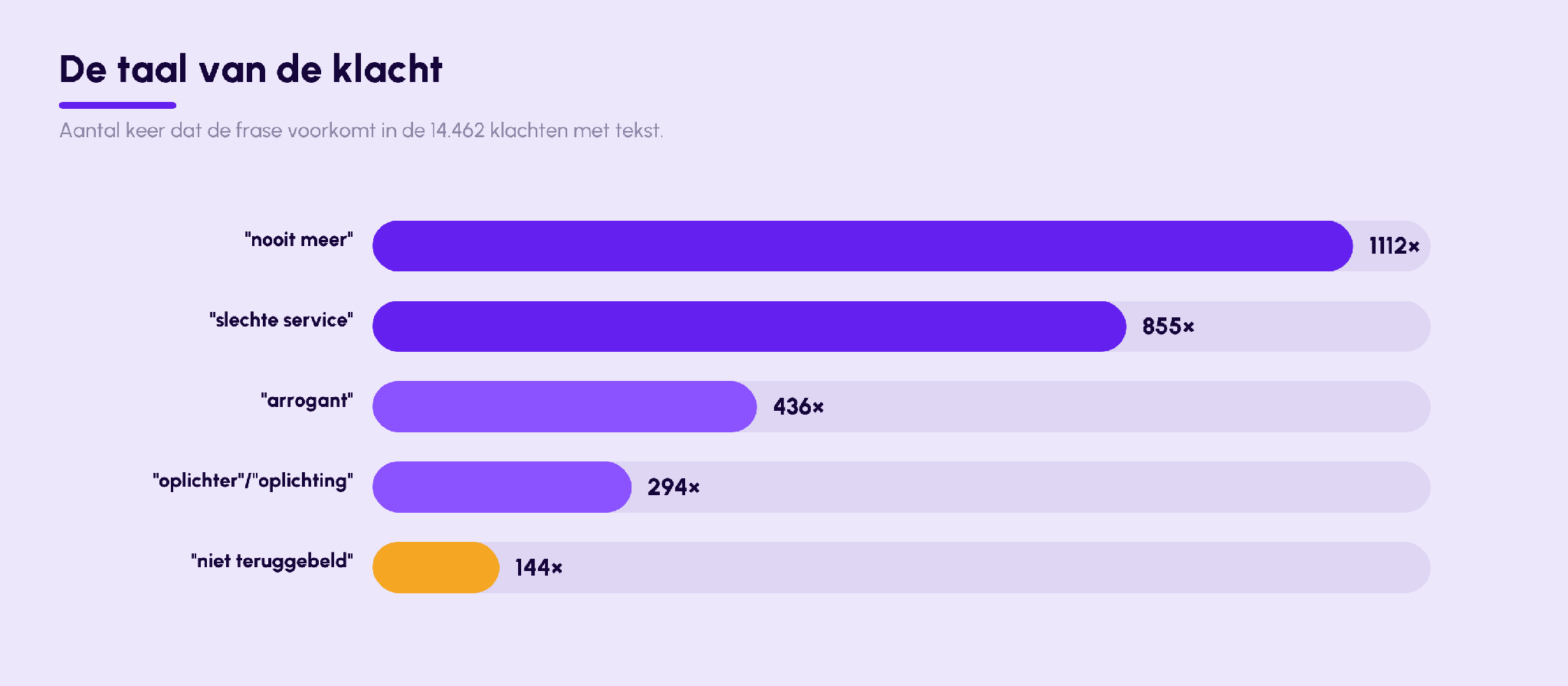
Striking: the smallest theme is the most dangerous. Complaints about trust (fraud, promises not kept) stay unanswered most often, in 51 percent of cases. And the language is harsh. Within the complaints, "never again" appears 1,112 times, "bad service" 855 times, "arrogant" 436 times, "scammer" or "scam" 294 times and "not called back" 144 times. That is bad news and good news at once: process complaints come back every week as long as nobody changes the process, but they are also steerable. A car that disappoints cannot be undone, a customer who had to call three times can.
The aftersales gap did not exist in 2019
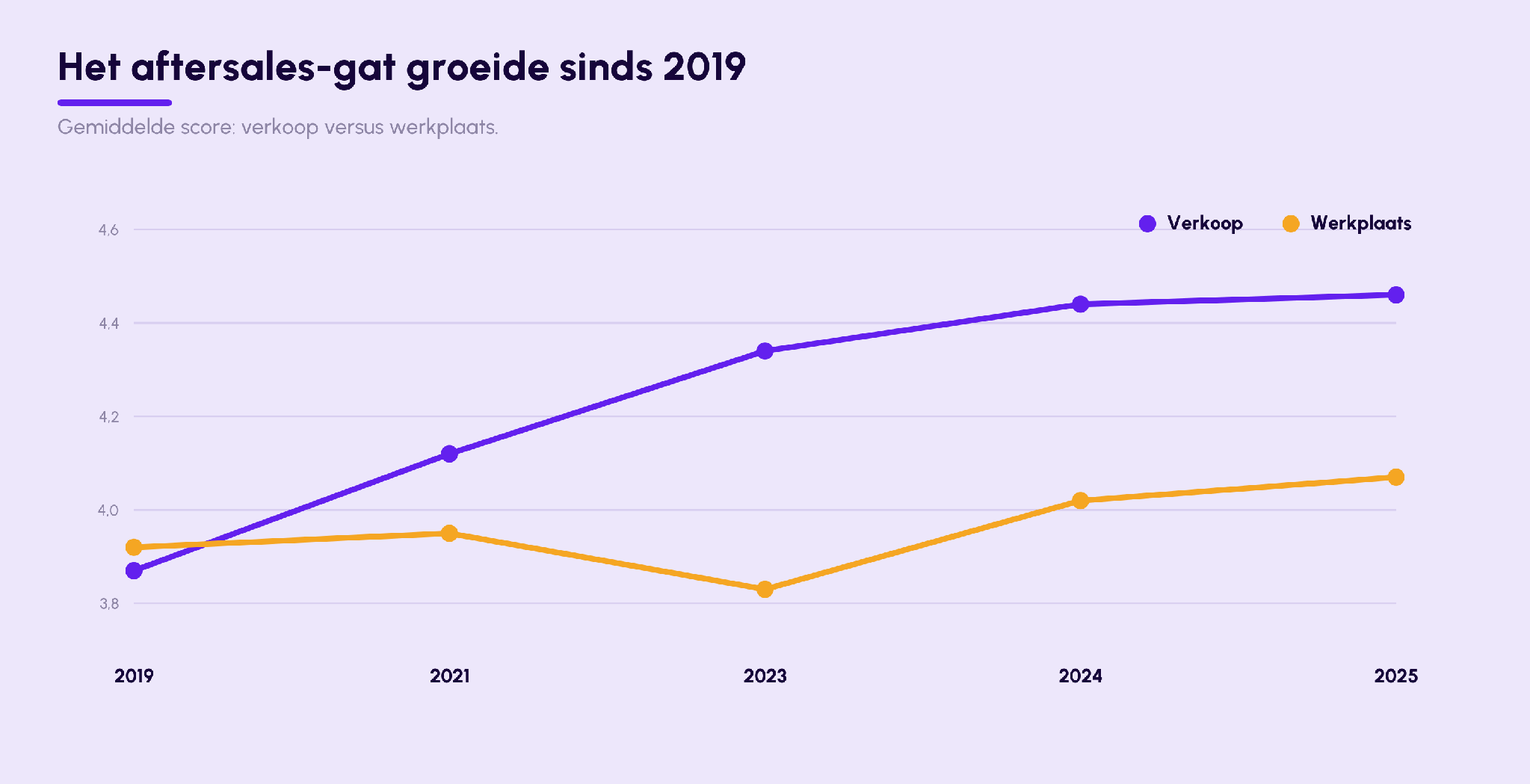
| Year | Sales | Aftersales | Gap |
|---|---|---|---|
| 2019 | 3.87 | 3.92 | −0.05 |
| 2021 | 4.12 | 3.95 | 0.17 |
| 2023 | 4.34 | 3.83 | 0.51 |
| 2024 | 4.44 | 4.02 | 0.42 |
| 2025 | 4.46 | 4.07 | 0.39 |
Nobody saw this coming. We tracked the scores of sales and workshop reviews through the years. In 2019 they were equal. Then sales pulled away and the workshop stood still.
The gap is now 0.4 stars and has been stable for three years. The explanation is easy to guess: in the showroom the customer journey has been professionalized, with EV consultations, online configurators and delivery moments with a bow on top. The workshop remained a factory with a waiting room. The reviews register that difference mercilessly. There is another sting: 18.4 percent of aftersales reviews is a 1-star, against 12.3 percent at sales. The workshop does get answered slightly faster (28 hours median, against 36 at sales).
The reputation calendar: tires are the pain point of the year
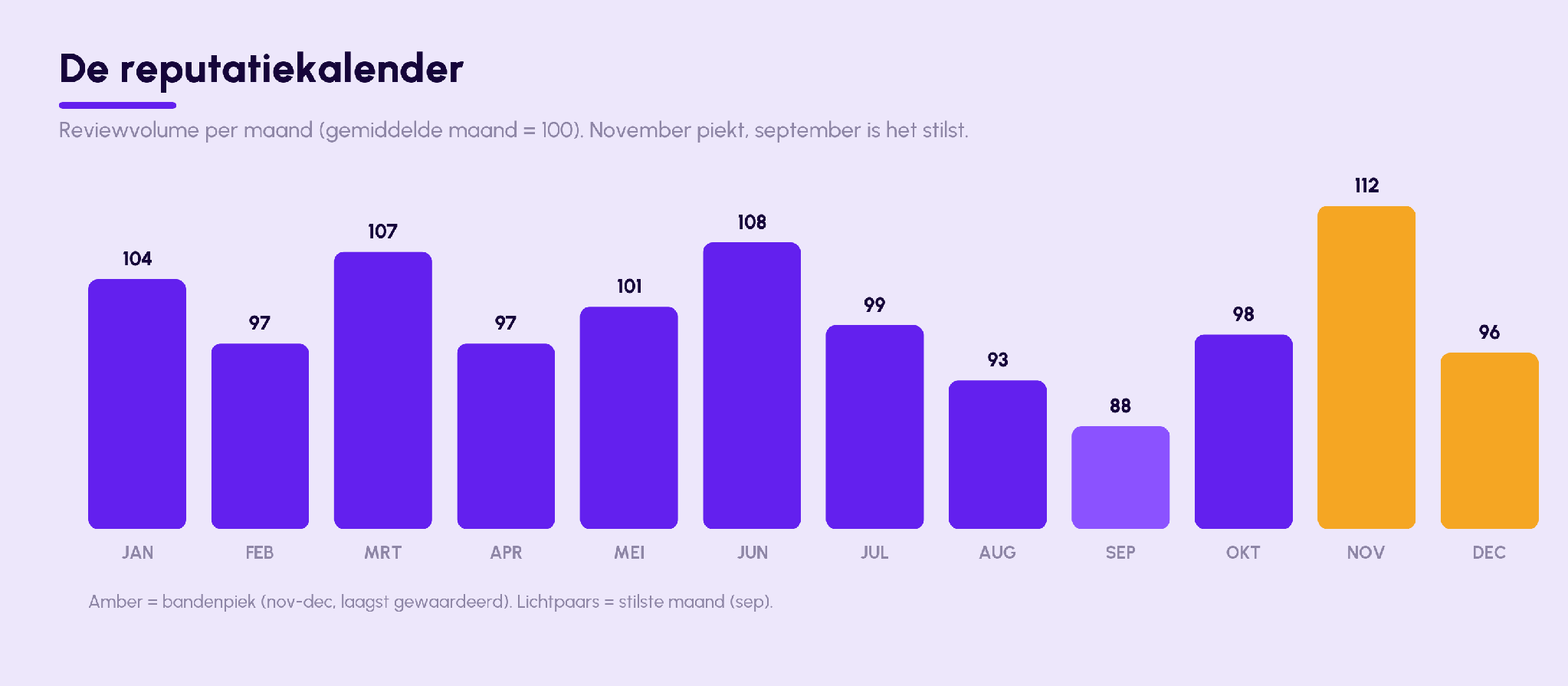
Review volume is not spread evenly across the year, and exactly at the busiest workshop moments the customer writes the lowest scores.
Tire reviews are the lowest-rated topic of the year at 3.35, and tire mentions double in November and December. The periodic roadworthiness test (the Dutch APK, comparable to the UK MOT) follows at 3.54 and peaks from March to May. Everything else scores 4.27, almost a full star above the tire moment.
For planning, this counts: November is the busiest review month of the year (index 112) and the start of the tire peak. Get your response process in order in October and you catch the heaviest month. September is the quietest month (88): the moment to clear the backlog. This is exactly what seasonal peaks in review volume are about.
Improving workshop customer satisfaction
The workshop decides whether a customer comes back, and that is exactly where the score gap sits. Start with the recurring complaint themes (waiting time, communication and the bill) and respond fast and visibly to every workshop review. How to use reviews to raise customer satisfaction in aftersales is in our guide on automotive reviews.
Start here
Give the workshop journey its own improvement plan with the complaint themes as the agenda: waiting time, communication and the bill. And have the response process ready before October, because the tire peak does not wait until you have time for it.
The classic mistake: explaining the gap away as a law of nature ("the workshop just takes the hits"). In 2019 it did not exist. What has grown can also shrink.
Curious where your dealer group stands?
We benchmark your locations against these figures free of charge: score, response rate, response time and complaint gap, per location. One overview, no obligations.
Frequently asked questions
What is the aftersales leak?
The aftersales leak is the score gap between sales reviews and workshop reviews. Sales reviews score an average of 4.27, workshop reviews 3.95. The showroom wins the customer, the aftersales loses them.
What are most car complaints about?
About the process, not the car. The biggest themes are waiting time and appointment (32 percent), workshop and repair (31 percent) and sales (28 percent). Complaints about trust stay unanswered most often (51 percent).
Since when does the aftersales gap exist?
Only since after 2019. Back then, sales and workshop scores were equal (3.87 versus 3.92). The sales experience was rated better year after year, the workshop stood still. The gap is now 0.4 stars and stable for three years.
When is the workshop's reputation under the most pressure?
In November and December. That is when review volume peaks (index 112 in November) and tire mentions double, while tire reviews score lowest of the year at 3.35.