
Reviews and AI visibility is about what AI assistants pick up from your reviews and pass on. The car buyer sees your website less and less, and more and more often an AI summary of your Google profile, and that summary is largely built on reviews.
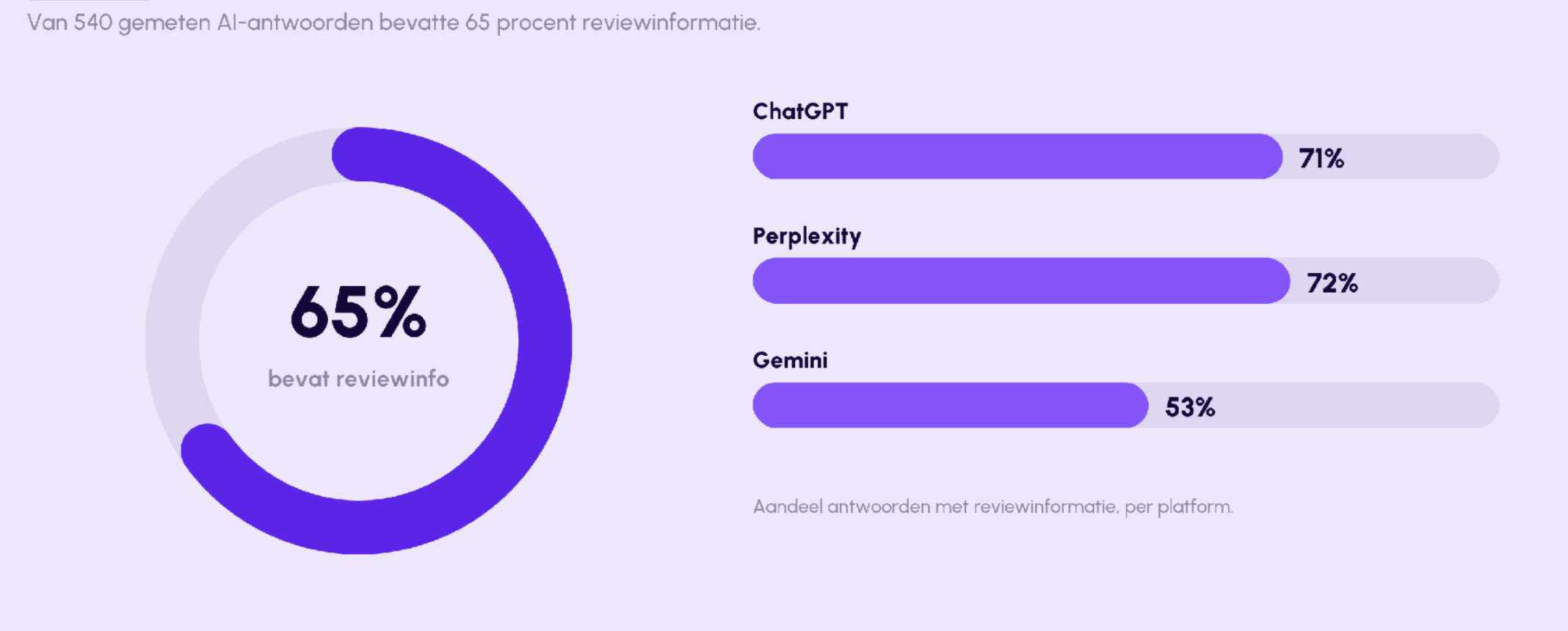
The AI visibility measurement of the Automotive Google Review Study 2026 by Repmanager (540 answers from ChatGPT, Perplexity and Gemini about car dealers in the Netherlands) shows that 65 percent of AI answers contain review information.
What ends up in there, you do not control with advertising. You control it with reviews, and with what you answer to them. Because the AI does not just read your reviews. It also reads your silence.
Your review profile has become your shop window
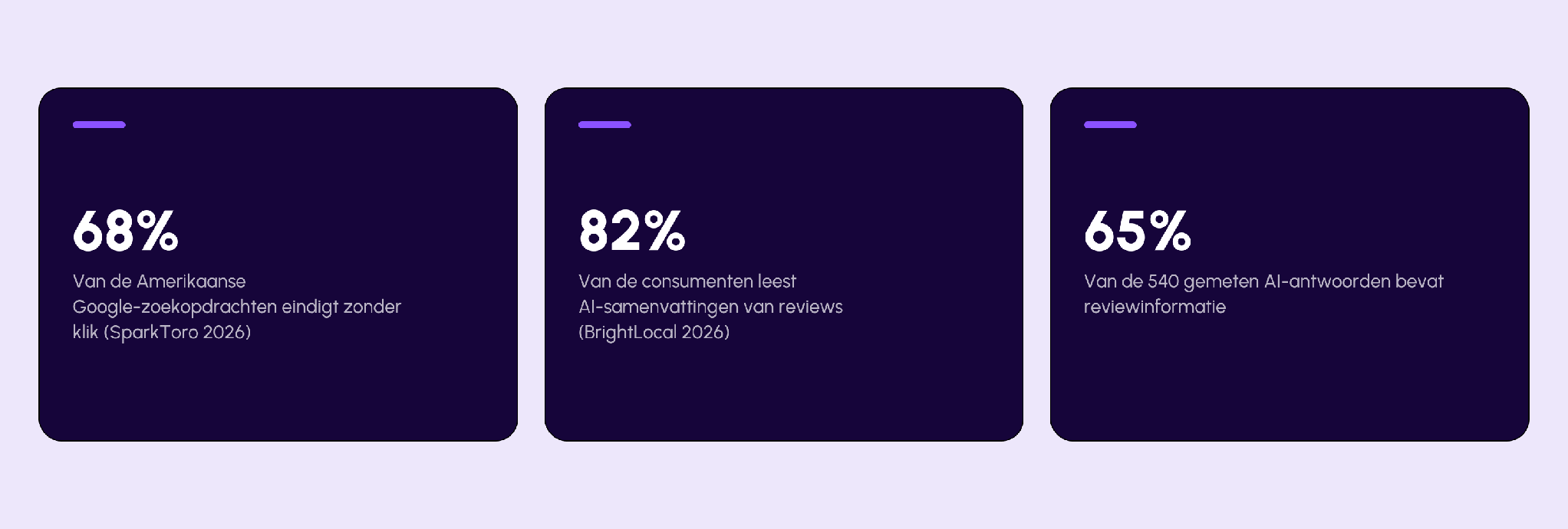
The way a car buyer orients is shifting. 68 percent of searches now ends without a click to a website (SparkToro/Datos, US, 2026). The buyer reads the answer, and your reviews, on Google itself or in an AI summary. 82 percent of consumers read those AI summaries of reviews, and 80 percent are more likely to choose a business that responds to all its reviews. 42 percent drop out at a business that ignores reviews.
This is not a future scenario. Google has said for years that the number of reviews, the score and the answers count toward your local ranking, and independent research now weighs review signals at around 20 percent of local ranking (Whitespark 2026). AI systems go a step further: they read the texts and summarize what they find.
The AI does not just read your reviews, it reads your silence too
That fundamentally changes the math of not responding. An unanswered complaint used to be one dissatisfied customer. Now it is source material: the complaint is there, your rebuttal is not, and the system summarizes what is there. In that light, the 12,147 open complaints at Dutch dealer groups from the complaint gap are not an archive but an outstanding bill.
And the public is already reading along. In our dataset, unanswered complaints get more thumbs up from other Google users on average than answered ones (1.17 against 0.97). Exactly where the dealer stays silent, bystanders click in agreement. Three things work, according to the numbers:
- Respond, to everything. 80 percent are more likely to choose a business that responds to all reviews. In our own data, response rate is the only behavior that consistently moves with a higher score (+0.29).
- Respond fast. 81 percent expect an answer within a week, a fifth the same day. The market sits at a median of 31 hours, on complaints 48. If you sit at 9 hours, you are visibly faster than nearly everyone. More on that in the response-time gap.
- Respond with substance. 54 percent of answers in the market mention the customer by name, 7 percent is an exact copy of an earlier answer. And a template answer makes 50 percent of consumers more likely to drop out.
We measured it: 540 AI answers
No assumptions about what AI "could" do, but looking at what actually comes out. In July 2026 we asked ChatGPT, Perplexity and Gemini the question a car buyer asks, 540 times: "what is a reliable [brand] dealer in [region]?" Sixty brand-region combinations in the Netherlands, covering all 30 largest Dutch dealer groups, 180 answers per platform, every answer recorded.
The outcome in one sentence: your review reputation is already in the answer. In 65 percent of the answers, the AI referred to scores, review counts or what customers write (ChatGPT 71 percent, Perplexity 72 percent, Gemini 53 percent). Meanwhile, review platforms themselves are almost never cited as a source: just 6.5 percent of the 1,034 cited sources is a review platform. The AI mainly cites dealer sites (56 percent) and comparison sites (25 percent), and works the review information into its judgment silently. And the battle is already on: 94 percent of purchase questions returns at least one of the 30 largest Dutch dealer groups.
What you can and cannot steer
Whether you get mentioned correlates in this first measurement mainly with size. Review volume, a measure of scale, is the strongest predictor (r = 0.45). Score and response rate do not predict it yet. So getting mentioned is a matter of locations and findability.
But what gets said about you, your reviews control. Independent research confirms the pattern: Seer Interactive analyzed 804,491 AI answers (March 2026) and saw the share of review sources in citations grow from 1.5 percent for orientation questions to 24 percent at purchase intent. And ChatGPT explicitly names the absence of reviews as a downside.
"Ask ChatGPT where to reliably buy a used car, and as a large dealer we simply do not appear in the results. That negative score is the trigger not to mention us." - Marketing Manager of a premium dealer, in conversation with Repmanager
The conclusion: whether you are in the AI answer is determined by your scale. How you appear in it is determined by your reviews and your answers. The first you cannot choose, the second you can.
How visible is my business in LLMs?
Your visibility in LLMs like ChatGPT, Perplexity and Gemini depends mainly on your reviews: 65 percent of the measured AI answers contained review information. Want to know what the AI says about your locations right now? Ask the purchase question yourself ("a reliable [brand] dealer in [region]") in ChatGPT and Gemini. That is your free baseline, and it takes five minutes.
Start here
Ask ChatGPT and Gemini today what they say about your locations. That is your AI baseline, it is free and it takes five minutes.
The classic mistake: waiting until AI search is "proven". The summaries are already there. And as long as you stay silent, the system only summarizes the complaint.
Curious where your dealer group stands?
We benchmark your locations against these figures free of charge: score, response rate, response time and complaint gap, per location. One overview, no obligations.
Frequently asked questions
Do AI assistants read your Google reviews?
Yes. 65 percent of the 540 measured AI answers (ChatGPT, Perplexity, Gemini) contained review information: scores, counts or customer judgments. The AI often works reviews in silently, without citing the review platform as a source.
What is zero-click and why does it matter for dealers?
Zero-click is a search that ends without a click to a website: 68 percent of US Google searches. The buyer reads the answer, and your reviews, on Google itself or in an AI summary.
Do reviews determine whether an AI recommends your dealership?
Whether you get mentioned correlates mainly with scale (review volume, r = 0.45). What gets said about you is determined by your reviews and your answers. At purchase questions, the share of review sources in AI citations grows to 24 percent (Seer Interactive, 2026).
How do you improve your AI visibility with reviews?
Respond to everything, respond fast and respond with substance. Template answers make 50 percent of consumers more likely to drop out. Start with a free AI baseline: ask ChatGPT and Gemini what they say about your locations right now.