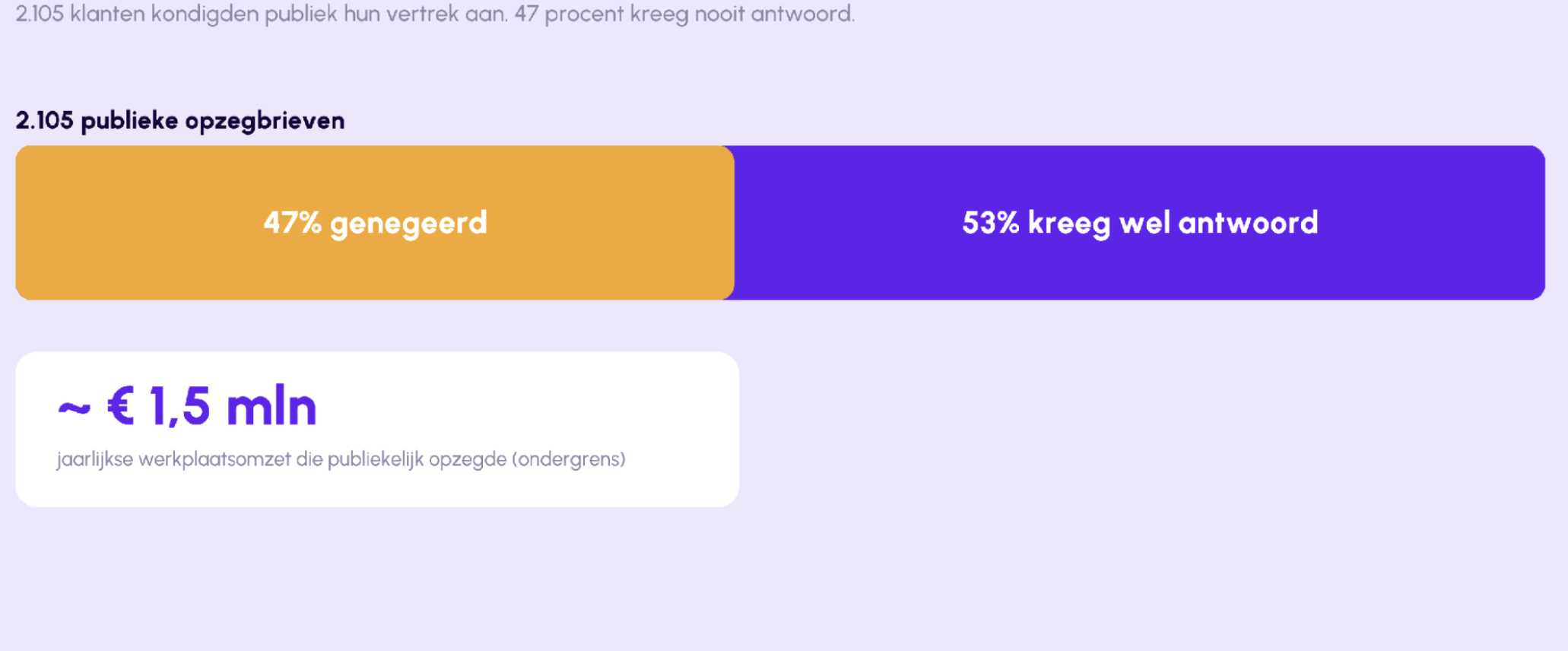

The farewell gap is the share of public departure announcements that stays unanswered. The Automotive Google Review Study 2026 by Repmanager (204,976 Google reviews of the 30 largest dealer groups in the Netherlands) shows that in 2,105 reviews a customer literally announces their departure and that 47 percent of those never get an answer.
The term "the farewell gap" was introduced in the Automotive Google Review Study 2026 by Repmanager.
These are not ordinary complaints. These are public resignation letters, and almost half disappear unanswered into the archive. The next buyer reads them. And by now, so does the AI assistant summarizing your location.
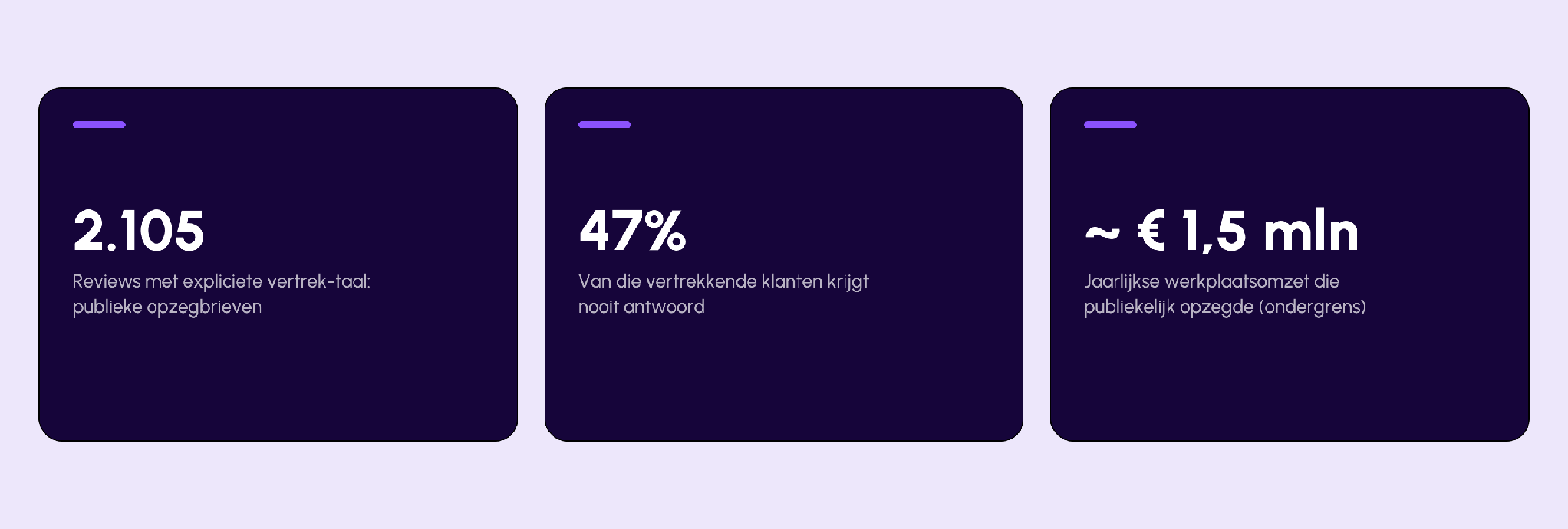
| Key figure | What it means |
|---|---|
| 2,105 | Reviews with explicit departure language: public resignation letters |
| 47% | Of those departing customers never get an answer |
| ± € 1.5 million | Annual workshop revenue that publicly resigned (lower bound) |
Public resignation letters nobody answers
In 2,105 reviews it is there in black and white: "never again", "last time", "I am going to another dealer". We found them with a fixed word list on the 1- to 3-star reviews of the 30 largest Dutch dealer groups. They are the clearest departure signals a customer can give.
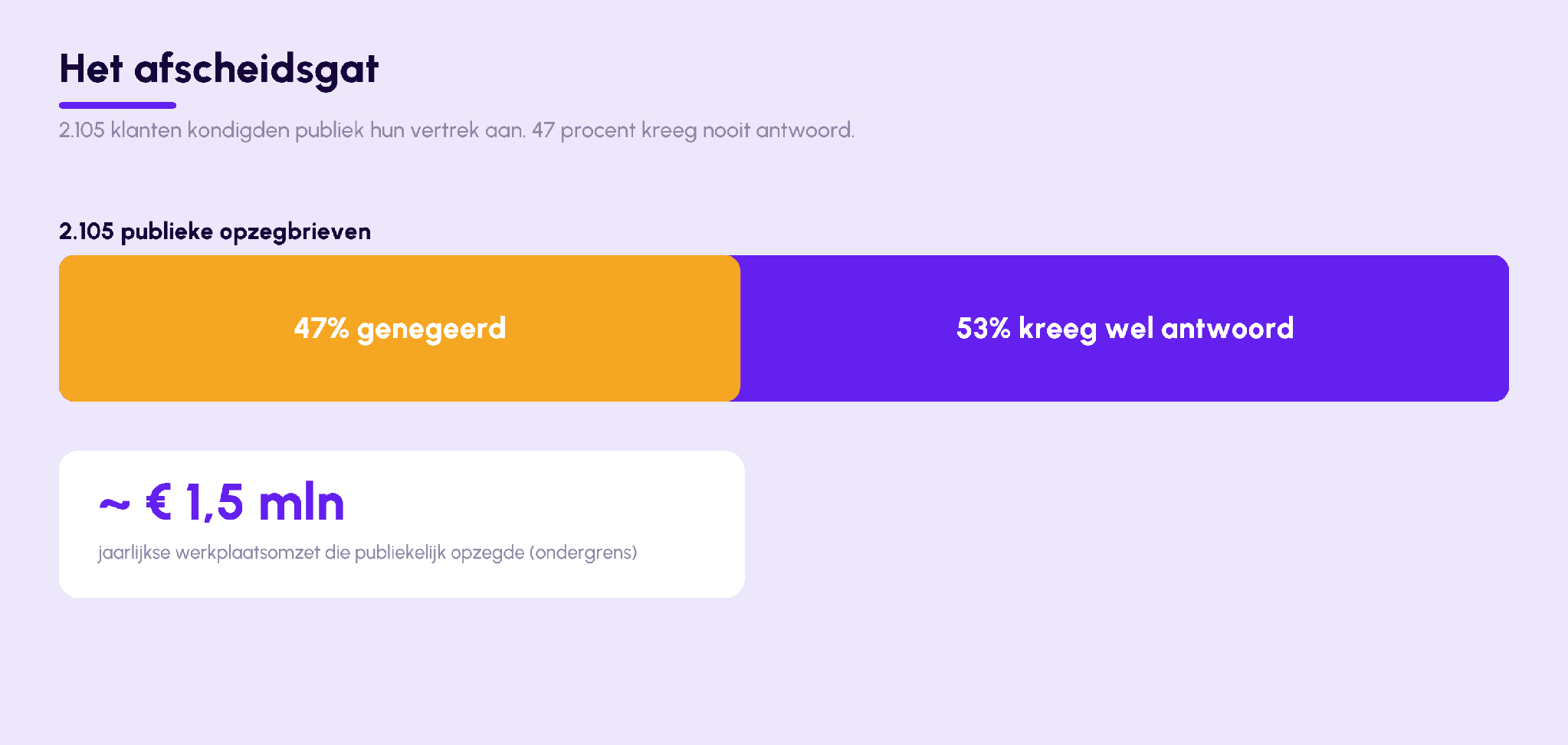
Almost half never get an answer: 47 percent. And those who do get one wait a median of 48 hours for it. Put that next to the loyal fan. The customer who lets you know in a 4- or 5-star review that they have been "a customer for years" or will "definitely come back" gets a thank-you after 24 hours, and is ignored in just 32 percent of cases. So dealers respond fastest and most often where it is needed least. The fan who stays gets thanked. The customer who leaves waits twice as long for an answer that never comes in half the cases.
The departing customer tells you exactly why. For free.
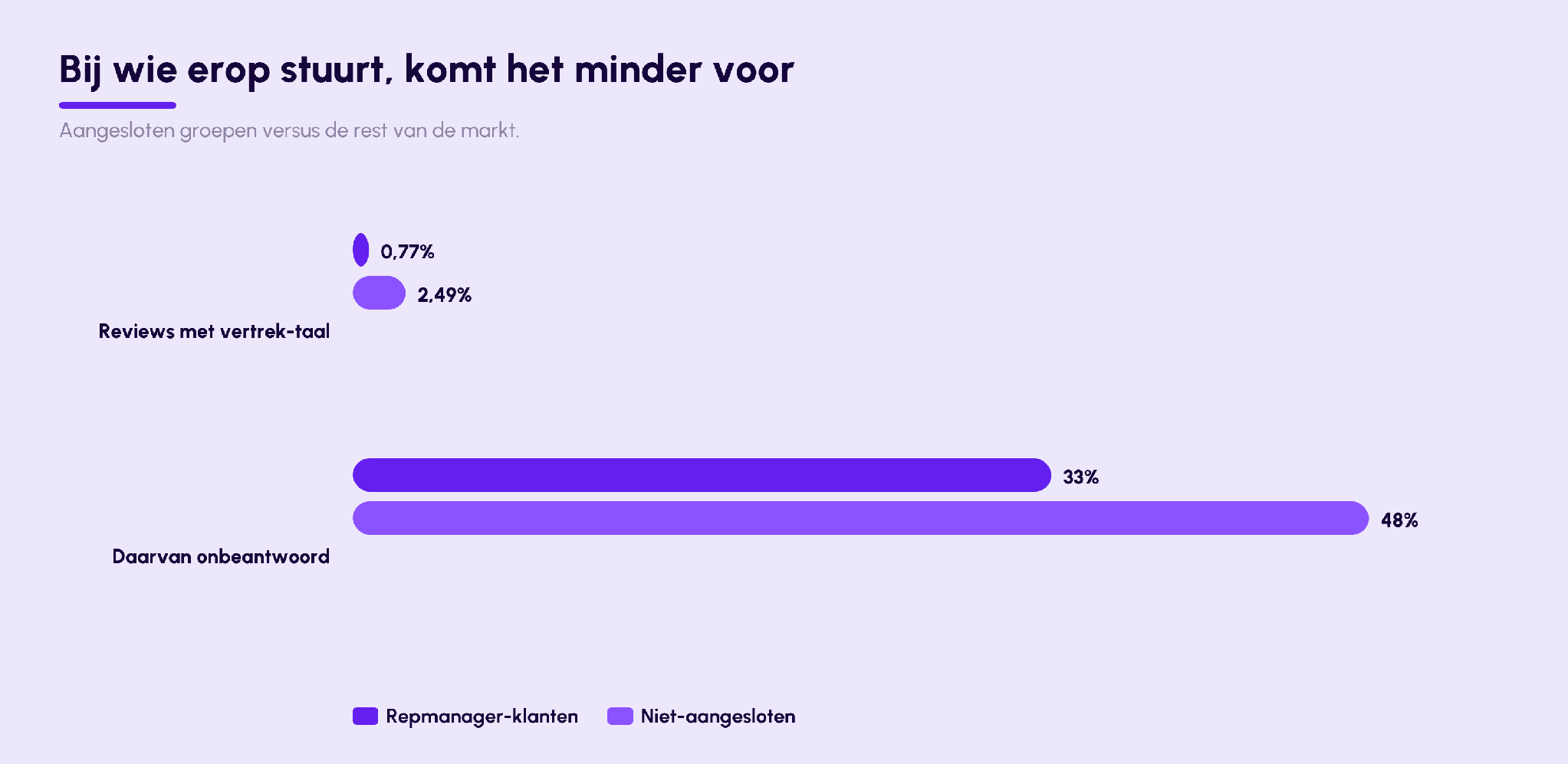
| Metric | Repmanager customers | Non-affiliated |
|---|---|---|
| Reviews with departure language | 0.77% | 2.49% |
| Of which unanswered | 33% | 48% |
A departure review is not a two-line outburst of rage. On average it counts 701 characters, more than three and a half times the average review length. The customer who leaves takes the time to explain what happened, what they expected and where it broke.
That makes the farewell gap doubly wasteful. This is the most information-rich customer signal you get for free: an exit interview that writes itself. And almost half disappears unread and unanswered.
The trend is moving in the right direction, but slowly. In 2021, 52 percent of departure announcements went unanswered, in 2025 still 29 percent. So even in the best market year ever, almost a third of customers who publicly resign are ignored. That the underlying response problem is broader shows in the complaint gap and in the response-time gap.
What does the farewell gap cost? A cautious calculation
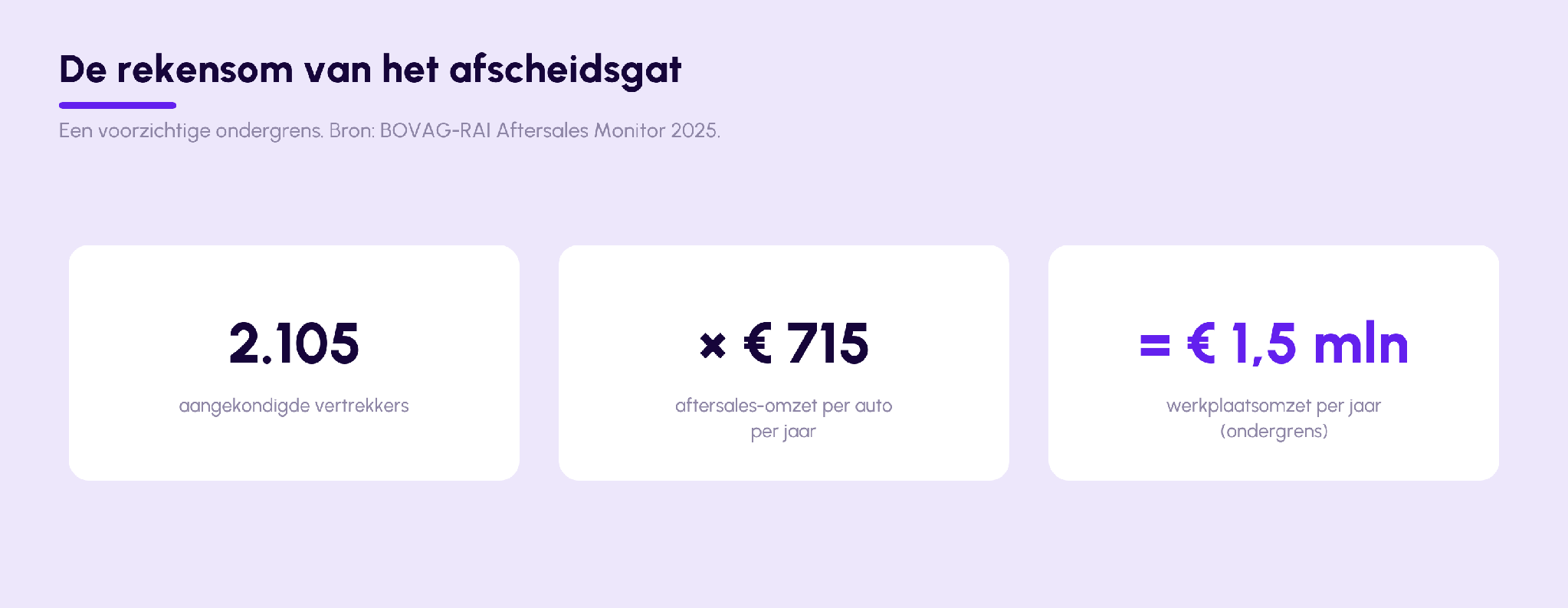
Percentages hurt, euros hurt more. So we calculate cautiously. According to the BOVAG-RAI Aftersales Monitor (published by the Dutch automotive trade associations), a Dutch car owner spent an average of 715 euros per year on maintenance and repair in 2025. That is the revenue that travels with a customer, every year again.
In our dataset, 2,105 customers explicitly announce their departure. Take their word for it, and roughly one and a half million euros of annual workshop revenue is walking out the door at the 30 largest Dutch dealer groups (2,105 x 715 euros = 1,505,075 euros). Just from the customers who wrote it down out loud.
And that is a lower bound, for three reasons. The silent leaver, who simply stays away without a review, is not counted here. A departed customer does not stay away one year but years. And every unanswered farewell letter gets read by the next buyer. Set the cost of the alternative against that: answering those 2,105 reviews would have been a few weeks of work. It is the cheapest retention program in existence.
For those who manage it, it happens less
At dealer groups that structurally manage reviews, departure language occurs more than three times less often: 0.77 percent of their reviews, against 2.49 percent in the non-affiliated market. And if someone does announce their departure, they more often get an answer: 33 percent unanswered at the affiliated groups, against 48 percent for the rest.
Partly that is because complaints are caught earlier, the customer does not have to explode to be heard, and partly because delivery is simply better. An honest caveat: this is a correlation at group level, not proof that one answer brings a leaver back. What is certain is that the answer is not there for the leaver alone, but for everyone who reads after them, and soon also for the AI assistant summarizing your location.
Lost a customer after a bad review: now what?
A customer who says goodbye publicly is not definitively lost yet. A fast, sincere response shows the leaver and everyone reading along that you take the complaint seriously, and sometimes even brings the customer back. How to build such a response without getting defensive is in the perfect response to a negative review.
Start here
Set one alert on departure language ("never again", "last time") and give those reviews an owner with a 24-hour target. It is a handful of reviews per month per group. This is not a capacity problem, this is a priority problem.
The classic mistake: putting departure reviews in the same queue as ordinary complaints. The customer has already resigned. Every day of silence confirms their decision, and the next buyer is reading along.
Curious where your dealer group stands?
We benchmark your locations against these figures free of charge: score, response rate, response time and complaint gap, per location. One overview, no obligations.
Frequently asked questions
What is the farewell gap?
The farewell gap is the share of public departure announcements that stays unanswered. Of the 2,105 customers who explicitly announce their departure in their review, 47 percent never got an answer.
How fast do dealers respond to a departing customer?
Those who get an answer wait a median of 48 hours. The loyal fan who stays gets an answer after 24 hours and is ignored in just 32 percent of cases. So dealers respond fastest where it is needed least.
What does the farewell gap cost?
As a cautious lower bound, roughly 1.5 million euros of annual workshop revenue at the 30 largest Dutch dealer groups (2,105 leavers x 715 euros average aftersales revenue per car per year, BOVAG-RAI 2025). The real cost is higher.
How do you prevent the farewell gap?
Set an alert on departure language like "never again" and "last time" and give those reviews an owner with a 24-hour target. It is a handful of reviews per month per group: a priority problem, not a capacity problem.